
The UK rental market offers investors diverse opportunities, but choosing between student tenants and professional renters remains one of the most debated decisions in property investment circles. Both segments present distinct advantages and challenges, from rental yields and vacancy periods to management intensity and capital growth potential. Understanding these differences is essential for investors seeking to maximise returns whilst managing risk effectively. This comprehensive comparison examines the critical factors that distinguish student housing investment from professional lettings, enabling you to make informed decisions aligned with your investment objectives.
Table of Contents
Rental Yield Comparison: Students vs Professionals
Student properties typically generate higher gross rental yields compared to professional lets, with returns often ranging between 5% and 8% in major university cities. This premium stems from multiple factors, including the ability to rent by the room rather than as a single unit, creating enhanced income potential from the same square footage.
Professional rentals, conversely, tend to deliver more modest yields, typically between 3% and 5.5% in most UK markets. However, these figures don’t tell the complete story.
Key yield considerations include:
- Per-room rental strategy: Student properties allow landlords to charge each occupant separately, maximising income from multi-bedroom properties
- Market location: Student yields peak in university towns with limited purpose-built accommodation, whilst professional yields strengthen in employment hubs
- Property specification: Higher-specification properties command premiums in the professional sector but may be unnecessary for student lets
- Rental duration: Students typically commit to 44-51 week contracts, creating predictable income patterns
Net Yield Reality
Gross yields present only part of the equation. Student housing investment often incurs higher management costs, maintenance expenses, and void periods that erode gross returns. Professional lets typically experience lower turnover, reduced wear and tear, and more straightforward management arrangements.
Cost Factor | Student Properties | Professional Properties |
|---|---|---|
Management Fees | 12-18% of rent | 8-12% of rent |
Annual Maintenance | £800-£1,500 per property | £400-£800 per property |
Void Periods | 8-16 weeks annually | 2-6 weeks annually |
Furnishing Costs | £5,000-£8,000 (3-bed) | £3,000-£5,000 (1-bed) |
The difference between gross and net yields can be substantial, with student properties sometimes delivering only 1-2% higher returns after all expenses are factored in.
Tenant Management and Time Investment
Student housing investment demands significantly more hands-on management compared to professional rentals. Students often require more support, particularly during move-in periods, and may lack experience managing household responsibilities. This translates into more frequent landlord contact, higher maintenance request volumes, and greater involvement in dispute resolution.
Professional tenants typically demonstrate more self-sufficiency and understanding of rental obligations. They’re more likely to handle minor maintenance issues independently and communicate more formally about property matters.
Management intensity factors:
- Communication frequency: Students may contact landlords 2-3 times monthly versus quarterly for professionals
- Maintenance requests: Student properties generate approximately 40% more maintenance calls annually
- Compliance requirements: Student HMOs (Houses in Multiple Occupation) face stricter licensing and safety regulations
- Deposit disputes: Students statistically contest deposits more frequently, though often without justification

Professional rentals offer the advantage of potentially engaging buy-to-let property investment strategies with lower management overheads, allowing investors to build portfolios more efficiently.
Seasonal Letting Cycles
The student market operates on a rigid academic calendar, creating intense competition during September-October letting periods. Properties not secured during this window often remain vacant until the following academic year. This seasonality requires precise marketing timing and can leave investors vulnerable to extended void periods.
Professional rentals benefit from year-round demand, with tenants relocating throughout all twelve months. This flexibility provides multiple opportunities to secure tenants and reduces the financial impact of unexpected vacancies.
Property Condition and Maintenance Considerations
Student properties experience accelerated wear and tear compared to professional lets. Multiple occupants, often living away from home for the first time, contribute to increased damage, cleaning requirements, and general deterioration. Carpets, furniture, kitchen appliances, and bathroom fixtures typically require replacement every 3-5 years in student properties versus 7-10 years in professional rentals.
The financial implications extend beyond replacement costs:
- Increased insurance premiums: Student properties often attract 15-25% higher contents insurance costs
- More frequent redecoration: Annual touch-ups versus bi-annual or tri-annual work
- Appliance stress: Washing machines, dishwashers, and other white goods experience heavier usage
- Garden maintenance: Student tenants rarely maintain outdoor spaces, requiring professional services
Professional tenants generally treat properties with greater care, partly due to longer tenancy durations creating a sense of home rather than temporary accommodation. According to recent market analysis, property condition remains a significant differentiator in total cost of ownership between these rental segments.
Furnishing Requirements
Student properties require full furnishing, including beds, desks, chairs, wardrobes, kitchen equipment, and living room furniture for each bedroom. This represents substantial upfront investment and ongoing replacement costs.
Professional rentals offer flexibility. Many professionals prefer unfurnished or part-furnished properties, reducing landlord capital outlay and maintenance responsibilities. When furnishing is required, it’s typically to a higher standard but for fewer occupants, balancing quality against quantity.
Vacancy Periods and Tenant Security
Student housing investment faces structural vacancy challenges. Even successfully let properties typically experience 8-12 weeks of vacancy during summer months, unless landlords actively pursue summer lets or short-term accommodation bookings. This seasonal void directly impacts annual returns and requires careful financial planning.
Professional properties in strong employment markets often achieve continuous occupancy for years. Tenants establish roots, particularly families or established professionals, creating stability that significantly enhances investment returns through reduced void costs and re-letting expenses.
Vacancy impact comparison:
Property Type | Average Annual Void | Lost Rental Income (£1,200 PCM) | Re-letting Costs |
|---|---|---|---|
5-Bed Student House | 10 weeks | £2,769 | £450-£650 |
1-Bed Professional Flat | 3 weeks | £831 | £350-£500 |
2-Bed Professional House | 4 weeks | £1,108 | £400-£550 |
These figures demonstrate how vacancy periods substantially affect net returns, potentially eliminating the gross yield advantage student properties initially appear to offer.
Tenant Turnover Rates
Students inherently represent transient tenants. Most remain for one academic year, with some extending to two or three years maximum. This guaranteed turnover creates predictable costs but also opportunities to increase rents annually in line with market rates.

Professional tenants frequently remain for 2-5 years, with families and older professionals sometimes staying even longer. Whilst this stability reduces costs, it can limit rent increase opportunities, as sitting tenants often resist market-rate adjustments more successfully than new tenants accept advertised rents. Understanding property investment fundamentals helps investors navigate these tenant relationship dynamics effectively.
Location and Capital Growth Potential
Student housing investment ties property performance directly to university reputation, enrollment figures, and purpose-built accommodation supply. Cities with prestigious universities and limited student housing stock offer strongest prospects, but remain vulnerable to policy changes affecting international student numbers or university expansion plans.
Capital appreciation in student areas can lag behind professional residential markets. Properties optimised for student lettings (multiple small bedrooms, minimal living space, basic specifications) may not appeal to owner-occupiers or professional renters, limiting exit strategy options and potential capital growth.
Professional rental properties in strong employment centres typically demonstrate more robust capital growth aligned with general residential market trends. These properties maintain broader appeal across multiple buyer segments, enhancing liquidity and long-term appreciation potential.
Market Resilience Factors
The student market shows vulnerability to specific risks:
- Enrollment fluctuations: International student visa restrictions or university funding changes directly impact demand
- Purpose-built competition: Large-scale PBSA (Purpose-Built Student Accommodation) developments can rapidly oversupply local markets
- Demographic shifts: Declining youth populations in some regions threaten long-term demand sustainability
- Distance learning trends: Increased online course provision reduces accommodation requirements
Professional rental markets demonstrate different resilience patterns. Employment market strength, housing affordability challenges, and mortgage availability constraints drive professional rental demand, factors largely independent from student market dynamics. Recent insights from student housing market analysis highlight these distinctions across different geographies.
Regulatory and Compliance Requirements
Student properties, particularly HMOs accommodating five or more unrelated tenants, face substantially more complex regulatory requirements than standard professional lets. These include:
Mandatory HMO licensing requirements:
- Property must meet minimum room size standards (6.51 square metres for rooms used by one person over 10 years old)
- Adequate bathroom and kitchen facilities based on occupant numbers
- Fire safety measures including detection systems, escape routes, and fire doors
- Five-yearly licensing renewal with associated fees (£500-£1,100 depending on local authority)
- Routine local authority inspections
- Enhanced electrical, gas, and furniture safety compliance
Professional single-household lets avoid most HMO requirements, operating under standard residential tenancy regulations. This reduces compliance costs, inspection frequency, and regulatory burden.
Additional Licensing Schemes
Many university cities have implemented Additional or Selective Licensing schemes specifically targeting student rental areas, adding further costs and administrative requirements. These schemes can require licenses for properties housing even two or three unrelated tenants, extending HMO-style regulation to smaller properties.
Professional rental areas less commonly face such intensive licensing, though some local authorities implement selective licensing in areas with high rental proportions. The regulatory trend currently intensifies requirements for student housing investment more aggressively than professional lettings.
Financing and Mortgage Considerations
Lenders often view student housing investment differently from standard buy-to-let mortgages, particularly for HMO properties. This affects both availability and pricing:
- Higher deposit requirements: HMO mortgages typically require 25-30% deposits versus 20-25% for standard buy-to-let
- Limited lender pool: Fewer mortgage providers offer HMO products, reducing competitive pressure
- Interest rate premiums: HMO mortgages often carry 0.5-1% higher rates than equivalent buy-to-let products
- Stricter stress testing: Lenders apply more conservative rental coverage calculations
Professional lettings benefit from broader mortgage product availability and more competitive pricing. Standard buy-to-let mortgages face less stringent qualification criteria, making portfolio expansion more accessible. Investors exploring various property investment opportunities should carefully evaluate financing implications across different rental segments.
Utility and Council Tax Responsibilities
Student households benefit from council tax exemption when all occupants are full-time students, creating financial advantages for both landlord and tenant. However, this places bill responsibility decisions squarely on the landlord. Many student landlords include utilities in rent, simplifying arrangements but increasing exposure to usage costs and bill management.
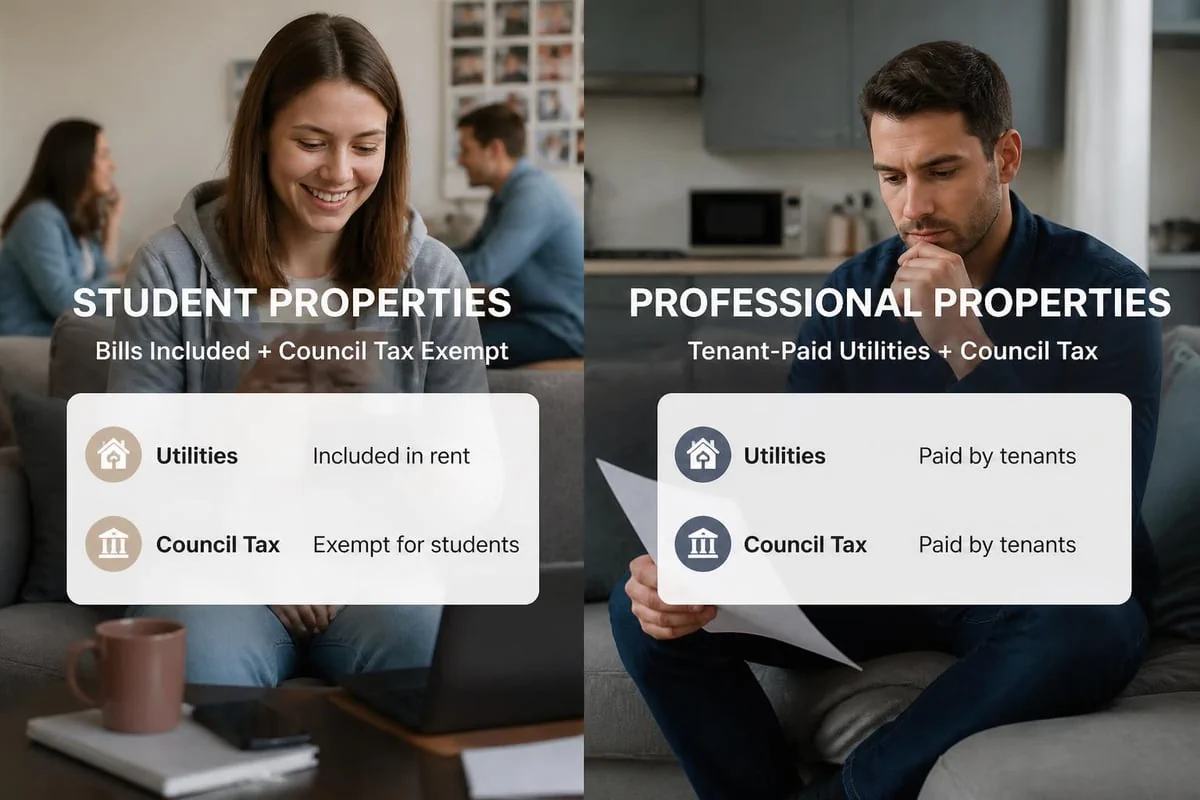
Professional tenants almost universally accept individual responsibility for utilities and council tax. This arrangement eliminates landlord exposure to bill variations, non-payment risks, and administrative burden associated with utility account management.
Bill inclusion considerations:
Approach | Student Properties | Professional Properties |
|---|---|---|
Bills Included in Rent | Common (60-70% of student lets) | Rare (5-10% of professional lets) |
Landlord Admin Burden | High (account management, switching, disputes) | Minimal (tenants manage directly) |
Rent Premium Opportunity | £50-£80 per tenant monthly | Not applicable |
Usage Risk Exposure | High (no occupant incentive to conserve) | None (direct payer conserves usage) |
The bills-inclusive model popular in student lettings creates additional management complexity but allows rent premiums that often exceed actual costs, contributing to higher gross yields.
Insurance Costs and Risk Profiles
Insurance providers categorise student properties as higher risk, resulting in premium loadings typically ranging from 20-40% above equivalent professional let policies. This reflects statistical evidence of increased claims frequency and severity in student accommodation.
Risk factors elevating student property insurance costs include:
- Contents claims: Higher theft, damage, and accidental loss rates
- Fire risk: Increased incidents from cooking accidents and smoking
- Malicious damage: Greater likelihood of intentional property damage
- Public liability: More frequent visitor-related incidents
- Unoccupancy: Extended summer void periods increase burglary and damage risks
Professional rental insurance remains more competitively priced, with landlords often securing comprehensive coverage for 30-40% less than comparable student properties. Lower claims history and reduced risk factors contribute to this differential.
Specialist vs Standard Insurance
Student landlords often require specialist insurance policies addressing HMO-specific risks and regulatory requirements. These policies provide necessary protections but command premium pricing reflecting concentrated risk exposure.
Professional landlords typically obtain adequate coverage through standard buy-to-let insurance products widely available across the insurance market. This broader availability creates competitive pricing pressure benefiting investors.
Market Entry Barriers and Initial Investment
Student housing investment often presents lower entry barriers regarding property acquisition costs. Suitable properties in student areas (terraced houses, older conversions) typically cost less per unit than professional rental properties in prime employment centres. A viable 5-6 bedroom student house might cost £180,000-£250,000 in provincial university cities, whilst equivalent yield from professional property in employment centres requires £200,000-£350,000 investment.
However, student properties demand higher post-acquisition investment:
- Conversion work: Adapting properties to HMO standards costs £15,000-£40,000
- Full furnishing: Equipping multiple bedrooms adds £5,000-£10,000
- Safety compliance: Fire doors, alarm systems, emergency lighting require £3,000-£8,000
- Licensing fees: Initial HMO licenses cost £500-£1,100
Professional properties often require minimal adaptation, particularly modern flats and houses already compliant with residential standards. Furnishing costs remain optional, and regulatory compliance expenses prove minimal.
Portfolio Scaling Considerations
Student portfolios scale differently from professional rental portfolios. Concentrated geographic requirement (proximity to specific universities) limits diversification opportunities. Investors must concentrate holdings in perhaps 2-3 viable university cities, increasing exposure to local market conditions.
Professional rental portfolios offer greater geographic flexibility, enabling investors to spread risk across multiple employment centres, regions, and property types. This diversification enhances portfolio resilience against localised economic downturns or market shifts. According to Walker & Dunlop’s market research, understanding these scaling dynamics proves essential for long-term investment success.
Demand Drivers and Market Fundamentals
Student housing demand correlates directly with higher education enrollment, particularly international student numbers. UK universities have experienced sustained international growth over the past two decades, but recent policy discussions regarding visa restrictions and enrollment caps introduce uncertainty into forward demand projections.
Professional rental demand responds to different fundamentals:
Primary demand drivers include:
- Housing affordability challenges: Rising house prices relative to incomes push more households into renting longer
- Mortgage accessibility: Stricter lending criteria exclude potential buyers, sustaining rental demand
- Employment migration: Job opportunities drive professional relocation and rental requirements
- Lifestyle preferences: Younger professionals increasingly value flexibility over ownership
These professional rental demand drivers demonstrate greater stability and fewer concentrated risks compared to student-specific factors. However, economic recessions impact professional rental demand more directly through employment losses, whilst student numbers often prove more resilient during downturns.
Demographic Trends
UK demographics show concerning trends for student housing investment. The 18-year-old population peaked in 2020 and is projected to decline through 2030 before stabilising. This demographic headwind threatens long-term student accommodation demand unless offset by increased participation rates or international student growth.
Professional rental demographics appear more favourable. The 25-44 age cohort, representing core professional rental demand, continues growing through 2030. Combined with delayed homeownership patterns, this supports robust professional rental market fundamentals for the foreseeable future.
Tax Treatment and Allowances
Both student and professional rental income face identical income tax treatment, subject to progressive tax rates based on an investor’s total taxable income. However, practical tax implications differ due to operational characteristics.
Student properties’ higher expense ratios (maintenance, management, furnishing) create larger tax-deductible costs, reducing taxable profit. This partially offsets lower net income, though the benefit depends on individual tax positions.
Deductible expense comparison (annual, 5-bed student vs 2-bed professional):
Expense Category | Student Property | Professional Property |
|---|---|---|
Management Fees | £2,400 | £1,100 |
Maintenance & Repairs | £1,200 | £600 |
Safety Compliance | £350 | £150 |
Insurance | £850 | £450 |
Furnishing Replacement | £800 | £300 |
Total Deductible | £5,600 | £2,600 |
Higher deductible expenses don’t necessarily improve tax positions if gross income differences don’t overcome expense gaps. Investors must model complete tax scenarios rather than focusing solely on gross yields.
Capital Gains Tax Considerations
CGT treatment remains identical for both property types upon sale. However, student properties optimised for maximum bedroom count (and therefore rental income) may achieve lower capital appreciation than well-specified professional properties, ultimately producing lower absolute CGT liabilities despite identical percentage rates.
Student property exit strategies sometimes prove more challenging, as the buyer pool primarily consists of other investors rather than owner-occupiers. Professional properties appeal to both investors and owner-occupiers, potentially achieving premium prices from buyers seeking homes rather than purely investment returns.
Risk Assessment and Investment Suitability
Student housing investment suits investors comfortable with:
- Higher management intensity: Active involvement or willingness to pay premium management fees
- Seasonal income patterns: Financial capacity to absorb extended void periods
- Regulatory complexity: Capability to navigate HMO licensing and compliance requirements
- Concentrated location risk: Acceptance of dependency on single-university market dynamics
- Higher turnover: Annual tenant replacement and associated costs
Professional rentals better suit investors preferring:
- Lower management burden: Less frequent tenant contact and maintenance requests
- Income stability: Year-round demand and minimal void periods
- Simpler compliance: Standard residential letting regulations
- Capital growth priority: Properties appealing to broader buyer markets
- Portfolio scalability: Geographic diversification across multiple markets
Neither investment type proves universally superior. Optimal choice depends on individual investor circumstances, including available time, management preferences, risk tolerance, and financial objectives. Many successful investors operate mixed portfolios, balancing student property yields against professional rental stability. Investors might also consider alternative property investment strategies offering different risk-return profiles entirely.
Tenant Behaviour and Relationship Dynamics
Student tenants typically demonstrate less property care awareness, though not necessarily through malicious intent. Inexperience managing independent living, combined with peer pressure and social activities, contributes to increased wear, occasional damage, and cleaning challenges.
Communication with student tenants requires different approaches. They respond better to digital channels (messaging apps, email) and often need explicit instruction regarding responsibilities that professional tenants intuitively understand. This necessitates more detailed tenancy agreements, comprehensive inventory documentation, and proactive rather than reactive management.
Professional tenants generally communicate more formally and demonstrate better understanding of contractual obligations. They value privacy and minimal landlord interference, preferring structured communication through proper channels rather than informal contact.
Deposit Protection and Disputes
Students contest deposit deductions more frequently, sometimes encouraged by parents or student advisory services. Whilst many challenges lack merit, they create administrative burden and occasional adjudication processes. Meticulous inventory documentation and photographic evidence prove essential for student properties.
Professional tenants dispute deposits less frequently, often accepting reasonable wear and tear deductions without challenge. When disputes arise, they typically focus on genuine disagreements about damage versus deterioration rather than blanket challenges to all deductions.
Market Saturation and Competition Analysis
Many university cities have experienced substantial purpose-built student accommodation (PBSA) development over recent years. These professionally managed developments offer students attractive amenities, city centre locations, and hassle-free all-inclusive packages. PBSA growth directly competes with traditional student housing investment, potentially suppressing rents and occupancy rates in affected markets.
Research from industry analysis indicates that traditional student landlords must differentiate through competitive pricing, superior locations, or enhanced specifications to compete effectively with PBSA operators.
Professional rental markets face different competitive dynamics. Build-to-rent (BTR) developments target professional renters in major cities, but supply remains insufficient to significantly impact demand-supply balances in most markets. Traditional buy-to-let investors continue dominating professional rental supply across most UK locations.
Competitive pressure assessment:
- Student market: High pressure from PBSA in city centres; moderate pressure in peripheral locations
- Professional market: Low to moderate pressure from BTR in major cities only
- Market share trends: PBSA capturing increasing student market share; BTR remains niche in professional sector
- Landlord response: Students require competitive pricing and specification upgrades; professionals maintain steady demand
Understanding local competitive dynamics proves crucial for investment success in either segment.
Exit Strategy Considerations
Student property exit strategies primarily rely on selling to other investors, limiting buyer pool size and potentially suppressing achievable prices. Properties configured with maximum bedrooms but minimal family living space struggle attracting owner-occupiers, particularly if located in areas dominated by student renters.
Conversion back to family homes often proves impractical due to layout modifications, planning constraints, and cost considerations. This locks investors into investment-only exit routes unless purchasing strategically in mixed-use areas where student conversion remains easily reversible.
Professional rental properties offer more flexible exit options:
- Sale to investors: Buy-to-let investors actively seek quality professional rental stock
- Sale to owner-occupiers: Well-maintained properties in good areas attract homebuyers, often achieving premium prices
- Market timing flexibility: Year-round sales potential rather than academic calendar constraints
This exit flexibility enhances professional property liquidity and potentially improves sale prices through broader buyer competition.
Portfolio Transition Strategies
Some investors initially pursue student housing investment for higher yields, planning eventual transition to professional rentals as equity builds and financial security improves. This strategy allows newer investors to maximise early returns whilst accepting higher management intensity, then graduate to lower-maintenance professional portfolios.
Alternatively, investors might combine both strategies simultaneously, using stable professional rental income to underpin higher-maintenance student properties’ cash flow variations. This diversification balances yield against stability, though requires sufficient scale to justify dual management systems.
Long-Term Sustainability and Future Outlook
Student housing investment faces several long-term challenges that investors must carefully consider. Beyond demographic headwinds, distance learning technology threatens traditional on-campus accommodation demand. Whilst COVID-19’s impact proved temporary, the demonstrated viability of remote education could gradually erode full-time residential study requirements.
Professional rental markets demonstrate more sustainable long-term fundamentals. Chronic housing undersupply, limited construction output relative to household formation, and structural affordability challenges suggest sustained professional rental demand for decades ahead. These macro trends provide confidence in long-term investment viability that student markets struggle matching.
However, student housing investment isn’t universally declining. Select markets with strong university reputations, international appeal, and constrained PBSA supply continue offering attractive opportunities. Investors must simply exercise greater selectivity and due diligence than previously required. Recent data from market tracking sources confirms this increasingly selective opportunity landscape.
Professional rental fundamentals appear robust, but face different risks including potential tax policy changes, regulatory burden increases, or economic downturns impacting employment and rental affordability. No investment proves entirely risk-free, requiring continuous market monitoring and strategy adjustment.
Both student housing investment and professional rentals offer viable opportunities within UK property markets, each suited to different investor profiles, objectives, and risk tolerances. Understanding the comprehensive differences across yields, management, tenants, regulations, and long-term sustainability enables informed decision-making aligned with your specific circumstances. Whether you prioritise immediate income, capital growth, management simplicity, or portfolio diversification, 365 Invest Limited provides tailored property investment solutions across multiple sectors and geographies, helping you build portfolios matching your goals. Explore how 365 Invest Limited can support your property investment journey with expert guidance and carefully selected opportunities.