Key Takeaways Click to Expand
- Buy-to-let mortgages are specialist mortgages designed for properties intended to be rented to tenants.
- A deposit of around 20% to 25% is common, although the amount required varies between lenders, properties and borrowers.
- Lenders assess rental income using affordability calculations such as Interest Cover Ratio, or ICR, and rental stress testing.
- There is no universal ICR or borrowing limit. Different lenders can offer different mortgage amounts against the same property.
- The lowest mortgage rate is not necessarily the cheapest option once product fees, broker fees and other charges are included.
- Interest-only mortgages can provide stronger monthly cash flow, but the outstanding capital must be repaid through a suitable exit strategy.
- First-time landlords, accidental landlords and portfolio landlords can access buy-to-let mortgages, but lender criteria can differ significantly.
- Limited company buy-to-let mortgages are available, but the costs, lending criteria and tax implications should be assessed before choosing the ownership structure.
- Mortgage approval does not mean a property is a good investment. Investors should assess rental income, financing costs, operating expenses, void periods, leverage and potential returns.
- The right buy-to-let mortgage should support the property’s financial performance and the investor’s wider property investment strategy.
Table of Contents
A buy-to-let mortgage is designed for a property you intend to rent out rather than live in. The central question is not simply whether you can afford the monthly payment from your salary. It is whether the expected rent, property type, deposit, borrowing structure and wider financial position meet a lender’s criteria – and whether the investment still makes commercial sense after all costs.
For most investors, the mortgage amount is shaped by two limits:
- Loan-to-value (LTV) – the maximum percentage of the property’s value a lender will finance
- Rental affordability – whether the rent passes the lender’s Interest Cover Ratio (ICR) and stress test
The lower of those two figures usually sets the maximum loan.
That matters because a property can look affordable at first glance, receive a mortgage offer and still produce weak or negative cash flow after mortgage interest, voids, management, maintenance, insurance, service charges and tax. Mortgage approval is a funding decision. It is not a verdict on investment quality.
What is a buy-to-let mortgage?
A buy-to-let mortgage is a loan secured against a residential property that will be let to tenants. It works broadly like a residential mortgage: you provide a deposit, borrow the balance and make monthly payments over an agreed term.
The underwriting is different. A residential lender mainly assesses whether your earned income can support the mortgage. A buy-to-let lender focuses heavily on the property’s expected rental income, while also considering your deposit, credit profile, ownership structure, experience and wider property portfolio.
Most buy-to-let mortgages are arranged on an interest-only basis. This means the monthly payment covers interest rather than repaying the loan balance. The original capital must be repaid at the end of the mortgage term, normally through a sale, refinancing, accumulated cash or another credible repayment strategy.
Buy-to-let lending is generally not regulated in the same way as a mortgage for a home you live in. However, an accidental landlord – for example, someone letting a former home after moving – may have a consumer buy-to-let mortgage, which is within the FCA’s regulatory perimeter. The FCA explains the distinction in its guidance on regulated consumer buy-to-let mortgages.
How do buy-to-let mortgages differ from residential mortgages?
The main difference is the lender’s affordability model.
Area | Residential mortgage | Buy-to-let mortgage |
|---|---|---|
Primary affordability test | Personal income and outgoings | Expected rent, usually supported by ICR testing |
Deposit | Can be relatively low for some products | Often larger, especially at competitive LTV bands |
Repayment basis | Usually capital repayment | Interest-only is common, repayment is available |
Rate and fees | Product-dependent | Product-dependent, often with higher arrangement fees |
Property use | Borrower’s main residence | Let to tenants under an appropriate tenancy |
Personal income | Central to affordability | May be secondary, but can still matter |
Portfolio assessment | Usually not relevant | Important for portfolio landlords |
Tax position | Mortgage interest is not a rental-business issue | Can materially affect post-tax cash flow |
The lender will also care about whether the property is straightforward to let and sell. A standard house or flat in an established rental market will usually have wider lender choice than a large HMO, ex-local authority flat, property above commercial premises, short-lease flat or off-plan development.
How does a buy-to-let mortgage application work?
The process begins with the borrower and property, not just the mortgage rate. A lender or specialist mortgage broker will usually assess your proposed purchase price, deposit, anticipated rent, ownership structure and circumstances before identifying potentially suitable products.
A typical application follows these stages:
- Initial fact-find and mortgage assessment – reviewing income, commitments, credit history, deposit source, property plans and ownership structure
- Agreement in principle – an initial lender indication, often subject to further checks
- Full application – including identification, bank statements, income evidence where required, property information and portfolio details
- Valuation – the lender instructs a surveyor to assess the property’s value and usually provide a rental valuation
- Underwriting – the lender tests LTV, rental affordability, credit history and policy criteria
- Mortgage offer – issued if the lender is satisfied, subject to conditions where applicable
- Legal work and completion – your solicitor handles the conveyancing and the mortgage funds are released on completion
The valuation can alter the economics of a deal. If the surveyor values the property below the agreed price, the lender will normally calculate LTV from the lower valuation. That can reduce the available loan and increase the cash required to complete.
For investors new to the process, our first-time buy-to-let guide covers the wider steps from planning a purchase to becoming a landlord.

What deposit do you need for a buy-to-let mortgage?
There is no universal buy-to-let mortgage deposit requirement. In practice, many investors use a deposit of around 20% to 40% of the purchase price, with 25% often used as a working assumption for a mainstream 75% LTV mortgage.
A larger deposit can improve more than the interest rate. It can also:
- Reduce the mortgage payment and rental coverage requirement
- Give access to more lenders or product options
- Improve resilience if rents soften or costs rise
- Reduce refinancing risk if property values fall
- Leave more headroom against valuation downfalls
However, putting more cash into one property is not automatically the right answer. It may reduce borrowing costs but also concentrates capital in a single asset. The decision should be tested against liquidity, diversification, cash flow and future borrowing plans.
Understanding loan-to-value
Loan-to-value (LTV) is the loan divided by the property value.
LTV formula:
Mortgage amount ÷ property value × 100 = LTV
For a £250,000 purchase with a £62,500 deposit:
£187,500 mortgage ÷ £250,000 property value × 100 = 75% LTV
A lender offering a maximum 75% LTV would not lend more than £187,500 on that valuation, even if the rent could support a larger loan.
Illustrative estimate: Deposit at 75% LTV
- Purchase price: £250,000
- Mortgage: £187,500
- Deposit: £62,500
Assumptions: Illustration only. Excludes Stamp Duty Land Tax, legal fees, valuation fees, broker fees, refurbishment costs, mortgage product fees and contingency funds.
Remember that acquisition taxes form part of the real cash requirement. In England and Northern Ireland, additional residential-property purchases generally attract higher SDLT rates. From 1 April 2025, the higher rates start at 5% on the first £125,000, then rise through the bands. HMRC’s higher-rate SDLT guidance sets out the current bands and examples. Scotland and Wales use different property transaction taxes.
How much can you borrow on a buy-to-let mortgage?
The short answer is: usually the lower of the lender’s LTV limit and the amount supported by the rental stress test.
Unlike a standard residential mortgage, a buy-to-let lender may not simply multiply your salary by a set figure. Instead, it assesses whether the expected rent covers the mortgage interest at a stressed rate by a required margin.
The core calculation is the Interest Cover Ratio, or ICR.
What is buy-to-let ICR?
ICR measures how much rental income covers the mortgage interest cost used in the lender’s affordability test.
ICR formula:
Monthly rent ÷ monthly stressed mortgage interest × 100 = ICR
If rent is £1,200 per month and stressed mortgage interest is £800 per month:
£1,200 ÷ £800 × 100 = 150% ICR
Lenders often use minimum ICR requirements such as 125%, 140% or 145%, but these are not universal rules. The required ratio can vary according to:
- Whether you buy personally or through a limited company
- Your tax status and personal income
- The property type and tenancy model
- Whether the product is fixed for five years or more
- Your experience as a landlord
- Your wider portfolio and exposure to other borrowing
- The lender’s current credit policy
Why lenders use a rental stress test
A lender does not usually assess affordability only at the initial product rate. It wants to know whether the rent could cover interest if rates rise or the loan moves onto a higher reversionary rate.
The Prudential Regulation Authority’s underwriting expectations require relevant lenders to consider interest-rate affordability and ICR testing. Where personal income is used to support affordability through top slicing, the PRA framework refers to a stressed rate of at least the higher of 5.5% or a 2 percentage point increase in mortgage rates. Lenders can apply their own, stricter criteria, and five-year-plus fixed products may be assessed differently. See the Bank of England’s buy-to-let underwriting standards.
This is why the same property can support very different mortgage amounts with different lenders.
Worked example: how rent, ICR and stress rates determine borrowing
Consider a standard buy-to-let flat valued at £250,000 with expected rent of £1,200 per month.
Assume, for illustration only:
- Maximum LTV: 75%
- Required ICR: 145%
- Stressed interest rate: 5.5%
First, calculate the maximum loan supported by rent:
Maximum loan formula:
Annual rent ÷ required ICR ÷ stressed interest rate
£14,400 annual rent ÷ 1.45 ÷ 0.055 = £180,564
The 75% LTV limit on a £250,000 property is £187,500. In this example, rental affordability is the limiting factor because £180,564 is lower than £187,500.
Illustrative estimate: Maximum mortgage based on rental stress testing
- Property value: £250,000
- Monthly rent: £1,200
- Annual rent: £14,400
- ICR requirement: 145%
- Stress rate: 5.5%
- Maximum loan supported by rent: about £180,500
- Maximum loan at 75% LTV: £187,500
- Likely maximum before other underwriting: about £180,500
Assumptions: Simplified example using gross rent and an interest-only affordability calculation. It excludes lender fees, personal income assessment, tax status, credit history, property restrictions, valuation outcomes and portfolio underwriting.
Now change only the lender’s criteria:
Lender scenario | ICR | Stress rate | Maximum loan supported by £1,200 pcm rent |
|---|---|---|---|
A – lower stress case | 125% | 5.5% | About £209,500 |
B – higher ICR | 145% | 5.5% | About £180,500 |
C – higher stress rate | 145% | 6.5% | About £152,700 |
The property, rent and borrower have not changed. The result has. That is why a specialist broker’s value is often in understanding lender criteria and structuring the application correctly, not simply locating a low headline rate.
What happens when a property fails the buy-to-let stress test?
Failing a lender’s rental stress test does not always mean the purchase is impossible. It means the proposed loan does not meet that lender’s affordability model.
The practical options may include:
- Increasing the deposit to reduce the required loan
- Selecting a lower-LTV product
- Using a lender with different ICR or stress-rate criteria
- Choosing a longer fixed-rate product where criteria may differ
- Demonstrating higher evidenced market rent, if the valuer agrees
- Using personal income through top slicing, where available and appropriate
- Reviewing whether a different ownership structure is suitable
- Reconsidering the property price or target asset
Do not treat a higher valuation or ambitious rental estimate as a solution to an affordability gap. The lender will usually rely on its own surveyor’s assessment of market rent and value. If the deal only works with an optimistic rent, it may also be commercially fragile.
Can personal income increase buy-to-let borrowing?
Sometimes. This is commonly known as top slicing.
Top slicing means the lender considers your surplus personal income as additional support where rental income alone falls short of the required ICR. It is more likely to be considered for borrowers with stable, evidenced income and manageable personal commitments.
Top slicing is not a universal feature. It can be limited by lender policy, tax status, existing mortgage exposure and the nature of the proposed property. The lender may also carry out a fuller assessment of household expenditure, dependants and committed spending.
For investors, the important distinction is this: top slicing can help secure a loan, but it can also mask a property with weak standalone cash flow. Using salary to support a short-term opportunity may be deliberate. Relying on it indefinitely to cover a structurally poor investment is a different proposition.
Mortgage affordability is not investment profitability
This is one of the most important buy-to-let mortgage principles.
A lender’s ICR test is designed to assess whether rent can support mortgage interest under a stress scenario. It is not a full investment appraisal.
It may not reflect your actual service charge, letting-agent fees, voids, maintenance cycle, refurbishment costs, insurance premiums, tax position or the capital you need to retain for unexpected repairs.
Worked example: a property can pass ICR but still lose money
Using the previous example, assume:
- Property purchase price: £250,000
- Mortgage: £180,560
- Monthly rent: £1,200
- Interest-only mortgage rate: 4.75%
- One month void each year
- Management fee: 10% of rent received
- Service charge: £2,400 a year
- Maintenance reserve: £1,000 a year
- Insurance: £250 a year
- Compliance and miscellaneous costs: £300 a year
The mortgage passed the earlier illustrative lender stress test at £1,200 pcm. But the cash flow calculation looks different.
Illustrative estimate: Pre-tax annual cash flow
- Gross annual rent: £14,400
- Less one month void: £1,200
- Rent received: £13,200
- Less management fee: £1,320
- Less service charge: £2,400
- Less maintenance reserve: £1,000
- Less insurance: £250
- Less compliance and miscellaneous costs: £300
- Less mortgage interest at 4.75%: about £8,577
- Illustrative pre-tax cash flow: minus £647 a year
Assumptions: Interest-only borrowing of £180,560 at 4.75%. One void month each year. Management fee charged on rent received. No rent growth, arrears, major works, refurbishment, ground rent, tax, capital repayment or purchase costs included. Actual costs and mortgage pricing will vary.
The monthly interest-only payment in this example is about £715. If the same loan were repaid over 25 years at the same illustrative rate, the monthly repayment would be about £1,029 – before all other property costs.
That does not make interest-only borrowing wrong. It shows why investors must assess the property and mortgage together.
A good appraisal should consider:
- Gross yield – annual rent divided by purchase price
- Net yield – annual rent less operating costs divided by purchase price
- Cash flow – money left after operating costs and mortgage payments
- Cash-on-cash return – annual pre-tax cash flow divided by the cash invested
- Equity growth – any reduction in mortgage balance and changes in property value
- Refinancing resilience – whether the rent and value could support the loan later
Our guide to rental yield calculations explains the difference between headline yield and the return left after real operating costs. For a wider view, read our guide to property investment returns.
Interest-only vs repayment buy-to-let mortgages
The choice between interest-only and repayment borrowing has a major effect on monthly cash flow and long-term risk.
Feature | Interest-only buy-to-let mortgage | Repayment buy-to-let mortgage |
|---|---|---|
Monthly payment | Lower at the same rate and loan size | Higher because capital is repaid |
Mortgage balance | Usually unchanged during term | Falls each month if payments are maintained |
End-of-term requirement | Full capital balance remains due | Loan should be repaid by term end |
Cash flow | Often stronger initially | Often tighter initially |
Interest paid over full term | Usually higher if debt remains outstanding | Usually lower because capital reduces |
Main risk | Refinancing or repayment strategy may fail | Higher payment can weaken monthly resilience |
An interest-only mortgage may suit an investor who wants to preserve cash flow and has a credible plan to repay or refinance the debt. That plan should not rely solely on assumed property price growth.
A repayment mortgage may suit an investor who prioritises debt reduction and is comfortable with lower short-term cash flow. But it should still be stress-tested: a repayment product can make a property unaffordable in practice even where an interest-only lender assessment passes.
Fixed, tracker and variable buy-to-let mortgage rates
Buy-to-let mortgage rates are usually offered as fixed, tracker or variable products.
Fixed-rate mortgages
A fixed-rate mortgage keeps the payable rate unchanged for a defined period, commonly two or five years. This can make cash flow more predictable and may make planning easier during the initial product period.
The trade-off is flexibility. Fixed products often include early repayment charges, which can be significant if you sell, refinance or repay early during the fixed period.
Tracker mortgages
Tracker mortgages follow a stated reference rate, commonly the Bank Rate, plus a fixed margin. Your payment can fall if the reference rate falls, but it can also rise quickly if the reference rate increases.
Variable and discount mortgages
A variable product can move at the lender’s discretion, while a discount mortgage offers a reduction against a lender’s standard variable rate for a set time. Both require careful review of the reversion rate after the initial period.
The right question is not “Which rate is lowest today?” It is:
Which product gives this property an acceptable cash flow, workable refinancing route and manageable downside if rates or rents move against the plan?
Why the lowest buy-to-let mortgage rate is not always the cheapest
The headline rate is only one part of the total cost of borrowing.
A lower-rate product can carry a larger arrangement fee. That fee may be paid upfront or added to the loan. Adding it to the mortgage reduces your immediate cash outlay but means you pay interest on it.
A higher-rate product with a low fee can be cheaper over a short fixed period, particularly where the loan amount is modest. Conversely, a fee-heavy low-rate product may be better for a larger loan or longer expected holding period.
Compare the whole product, including:
- Initial interest rate
- Arrangement or product fee
- Valuation fee
- Legal fees where applicable
- Broker fee
- Mortgage term
- Fixed or incentive period
- Reversion rate after the deal ends
- Early repayment charges
- Overpayment allowance
- Portability
- Product suitability for the property and borrower structure
A £1,995 fee is not “just £1,995” if it changes your LTV, is added to debt or makes the product unsuitable for a planned refinance in two years.
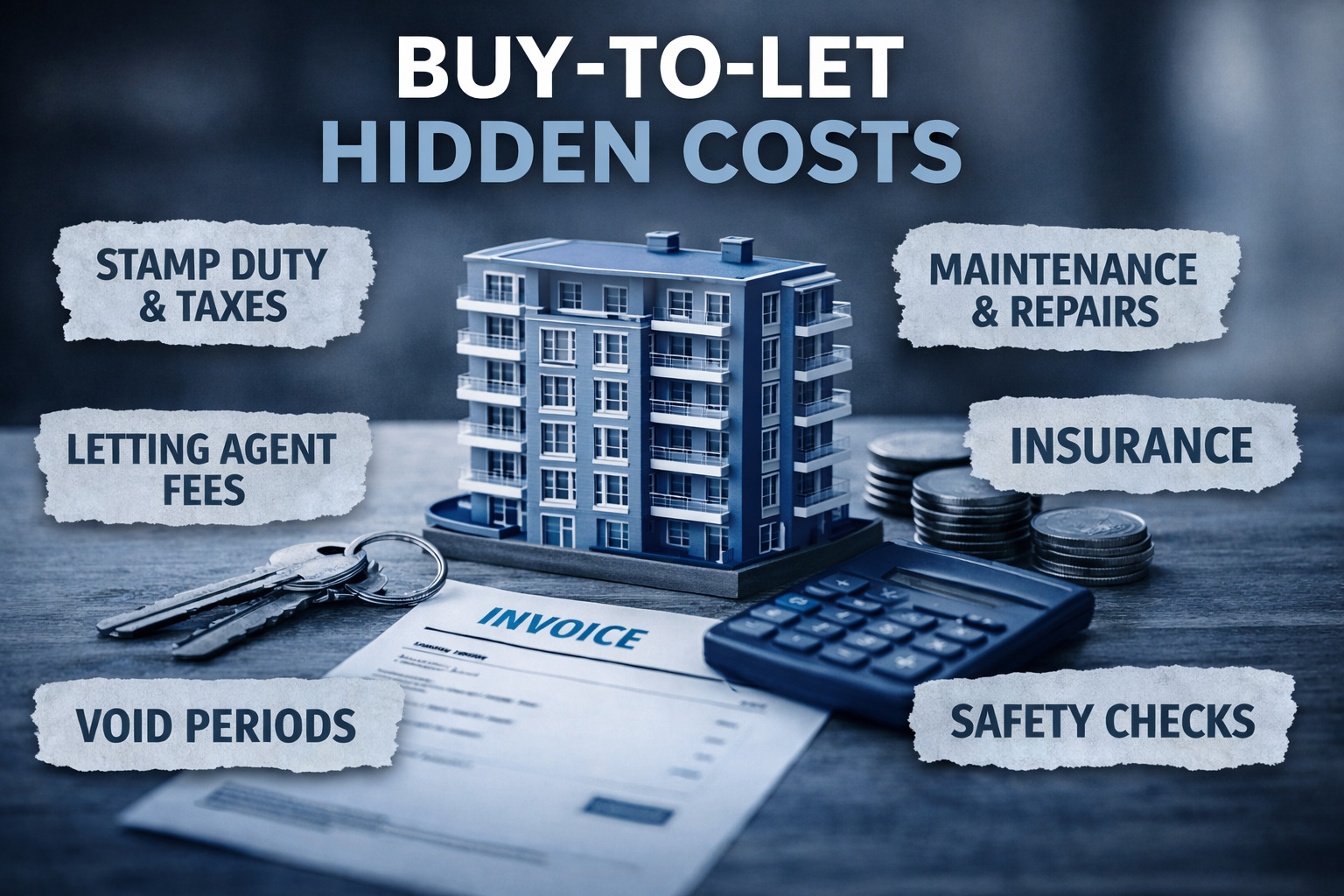
What are the main buy-to-let mortgage fees and costs?
Mortgage costs should be modelled before you exchange contracts, not treated as incidental extras.
Cost | What it covers | Investor consideration |
|---|---|---|
Arrangement or product fee | Lender charge for the mortgage product | May be flat or percentage-based |
Valuation fee | Lender’s assessment of property value and rent | Does not replace a detailed survey |
Broker fee | Advice, product research and application work | Check when it is payable and whether it is refundable |
Legal fees | Conveyancing and lender legal work | Can be higher for limited companies or specialist property |
Lender administration fees | Mortgage processing or completion charges | Review the product illustration |
Early repayment charge | Charge for leaving a product early | Important if planning a sale or remortgage |
Higher lending charge | Less common, but may apply in specialist cases | Check product terms |
Company costs | SPV incorporation, accounting and annual compliance | Relevant for limited-company purchases |
The purchase also requires funds beyond the mortgage: deposit, SDLT or the relevant devolved tax, solicitor fees, survey costs, reservation fees where applicable, initial refurbishment, furnishing, licensing, insurance and a contingency reserve.
Buy-to-let mortgage requirements and eligibility
Lender criteria vary, but the following factors commonly influence eligibility.
Credit history and adverse credit
A clean credit history usually gives access to a wider range of products. That does not mean adverse credit makes buy-to-let finance impossible. Specialist lenders may consider historic missed payments, defaults, CCJs, debt-management plans or previous mortgage arrears, depending on their age, size, explanation and whether they have been satisfied.
The trade-off may be a lower maximum LTV, higher rate, larger deposit or more limited lender choice. Be accurate and upfront. Credit issues discovered late can delay or derail an application.
Age, income and employment
Many lenders set minimum and maximum ages at application or mortgage expiry. They may require a minimum personal income, especially for first-time landlords or where rent does not fully support borrowing.
Employment type matters too. PAYE income is often straightforward to evidence, but self-employed applicants, contractors, company directors and overseas investors may need additional documentation.
Deposit source and proof of funds
Lenders and solicitors will need to understand where the deposit comes from. Savings, investments, property-sale proceeds, gifts and equity releases can all involve documentary evidence.
A deposit funded by borrowing may be acceptable to some lenders but requires transparent disclosure. It also changes the real affordability of the investment because the second loan has a cost.
Property type and tenancy
A lender assesses the security as well as the borrower. Restrictions can apply to:
- Flats above shops or other commercial premises
- Ex-local authority flats
- High-rise blocks
- Properties with short leases
- Studio flats or very small units
- Non-standard construction
- Listed buildings
- Holiday lets
- Student lets
- HMOs
- Multi-unit freehold blocks
- Properties needing substantial refurbishment
- New-build and off-plan properties
A property may be legally lettable yet unsuitable for a particular mortgage product. Finance should be checked before committing to a purchase.
Can first-time landlords get a buy-to-let mortgage?
Yes, many lenders accept first-time landlords. Some will also consider first-time buyers purchasing an investment property rather than a home for themselves.
However, first-time landlords may face tighter policy requirements. A lender may ask for a higher minimum income, a larger deposit, a lower LTV, landlord experience from another applicant or stronger rental coverage.
The lender may also take a closer look at how you will manage the property. That does not mean you need to self-manage, but you should understand the costs of professional management, tenant compliance and maintaining a cash reserve.
For first-time buyer investors, the strategic issue is not only mortgage eligibility. Buying a rental property before a main residence can affect future purchase costs and first-time buyer status. Take independent tax and legal advice before deciding on the purchase order.
What is an accidental landlord mortgage?
An accidental landlord is someone who lets a property because of a change in circumstances rather than an original investment decision. Common examples include moving in with a partner, relocating for work, inheriting a property or being unable to sell a former home.
If you have a residential mortgage, do not assume you can simply begin letting the property. You may need consent to let from your current lender, a product transfer or a consumer buy-to-let mortgage. Letting without permission can breach the mortgage terms and may invalidate insurance.
Accidental landlords should also model the property as an investment. Emotional attachment to a former home can lead owners to overlook weak rental yield, high costs or an unhelpful financing structure.
Portfolio landlord mortgages: what changes when you own four or more properties?
For many lenders, a portfolio landlord is a borrower with four or more mortgaged buy-to-let properties. The lender is likely to assess the whole portfolio, not just the new purchase.
Expect scrutiny of:
- Property addresses, values and loan balances
- Existing rents and tenancy status
- Mortgage payments and product end dates
- Portfolio ICR and exposure to rate rises
- Arrears, voids and historic performance
- Limited-company structures and directorships
- Future borrowing plans
The purpose is to identify whether a new loan adds resilience or stretches the wider portfolio too far. A property that works in isolation may not work if several other fixed-rate deals are due to expire in the same year.
That is why portfolio investors should maintain a refinancing calendar. Record each property’s loan balance, rate, ERC end date, fixed-rate expiry, estimated current value, rent, ICR and likely refinancing options at least 12 months before product maturity.
If your objective is to grow beyond a single asset, our guide on how to start a property portfolio sets out the wider planning considerations.
Limited company buy-to-let mortgages and SPVs
A limited company buy-to-let mortgage is borrowing taken by a company rather than an individual. Many investors use a special purpose vehicle, or SPV, created specifically to hold property.
The company owns the property and borrows the mortgage funds. Directors and shareholders are commonly asked to provide personal guarantees, especially for smaller SPV structures.
Why investors consider a limited company
The decision is often driven by tax, retained profits, succession planning or portfolio growth. For individual landlords, finance-cost relief on residential property income is restricted to a basic-rate tax reduction. HMRC’s guidance explains that the restriction applies to individual landlords, partnerships and trusts with residential-property finance costs.
Companies are taxed differently, and mortgage interest is generally treated within corporation-tax calculations. But that does not make a company structure automatically preferable. Taking money out of a company can create further tax considerations, and there are added legal, accounting and administrative costs.
Limited-company mortgage considerations
A company mortgage may involve:
- Fewer high-street lender options, but broad specialist-lender availability
- Personal guarantees from directors
- Different ICR requirements
- Higher product rates or fees in some cases
- Company incorporation and annual filing obligations
- Specialist conveyancing
- Accountant costs
- More complex refinancing and ownership changes
The correct structure depends on your circumstances, plans and tax position. Speak to an accountant or tax adviser before incorporating or transferring property into a company. Transferring an existing personally owned property can have tax and transaction-cost consequences.
HMO and specialist buy-to-let mortgages
An HMO can generate higher gross rent than a single-household let, but it also creates more operational complexity, tighter lender criteria and potentially higher costs.
In England and Wales, an HMO generally involves at least three tenants from more than one household sharing facilities. Large HMOs occupied by five or more people from more than one household normally require a licence, although local additional licensing and planning rules can capture smaller properties. Check the official HMO licensing guidance and the relevant local authority before making an offer.
Mortgage lenders may assess HMOs differently because of:
- Licensing and planning requirements
- Higher management intensity
- Fire safety and amenity standards
- Tenant turnover
- Individual-room versus whole-property tenancy structures
- Valuation methodology
- Rental income treatment
- Landlord experience requirements
The same principle applies to student lets, holiday lets, multi-unit blocks and semi-commercial property. Specialist assets need specialist underwriting and should be checked with a lender before you incur non-refundable costs.
New-build and off-plan buy-to-let mortgages
New-build and off-plan purchases can require more planning because mortgage offers have expiry dates, while construction programmes can change.
For a completed new-build purchase, lenders may apply different maximum LTVs, particularly for flats. For off-plan property, the key risk is that the mortgage product, valuation, borrower circumstances or lender criteria may have changed by completion.
Before reserving an off-plan property, clarify:
- The anticipated build completion window
- Whether the lender will consider the development
- The mortgage-offer validity period
- Whether an extension may be possible
- Deposit protection arrangements
- Your ability to fund a larger deposit if valuation falls
- The effect of a delayed completion on product availability
- Your exit plan if finance cannot be secured on the original terms
Do not rely on a mortgage illustration obtained at reservation as a promise of future lending.
Buy-to-let remortgaging and equity release
A buy-to-let remortgage replaces your existing mortgage with a new one. Investors remortgage to secure a new rate, reduce payments, switch from repayment to interest-only, change lender, add or remove borrowers, move into a company structure where appropriate or release equity.
Equity release occurs where the new mortgage is larger than the existing mortgage and the difference is drawn out as cash.
When remortgaging can make sense
Remortgaging may be worth investigating when:
- Your fixed or discounted period is ending
- The property value has increased
- Rental income has increased enough to improve affordability
- You want to release funds for another purchase or refurbishment
- Your existing lender’s reversion rate is uncompetitive
- A different product better matches your planned hold period
The risk of extracting equity
Equity release increases debt. It can improve liquidity or fund growth, but it also raises interest costs and can reduce cash flow. It may make the portfolio more vulnerable if rents fall, values decline or refinancing criteria tighten.
A sensible equity-release decision begins with the post-remortgage position. Model the new loan using the lender’s stressed affordability rules, then test actual cash flow at the new product rate and at higher rates. If the property only works in a favourable scenario, more borrowing may be adding fragility rather than flexibility.
Common reasons buy-to-let mortgage applications fail
Applications often fail because the borrower or property does not fit the lender’s criteria, rather than because buy-to-let finance is unavailable in general.
Common reasons include:
- Rent does not meet the ICR requirement at the lender’s stress rate
- The valuation is lower than the agreed purchase price
- The surveyor’s market-rent assessment is below the landlord’s expectation
- Deposit funds cannot be evidenced
- Credit problems are more recent or serious than disclosed
- Existing portfolio borrowing fails the lender’s aggregate stress test
- The property type falls outside policy
- Lease length, service charges or building issues concern the lender
- The borrower has insufficient income where a minimum is required
- The mortgage application details do not match bank statements, accounts or credit records
- The property requires licensing, planning consent or works that are not in place
- The product expires before a delayed transaction completes
The best prevention is early due diligence. Check the property, finance and legal position together before paying significant non-refundable fees.
How to choose a buy-to-let mortgage: an investor framework
Choose the finance after you understand the property’s investment case, not before.
A useful framework is to assess six connected questions.
1. Does the property work at a realistic rent?
Use comparable evidence, not the highest asking rent in the area. Ask what rent the lender’s valuer is likely to support and whether the property remains viable if rent is 5% to 10% lower or takes longer to let.
2. What is the true all-in cash requirement?
Include deposit, taxes, legal fees, mortgage fees, valuation, survey, furnishing, refurbishment, licensing, contingency and the cost of any initial void.
A lower deposit can increase your apparent return on cash invested, but it may also produce weaker cash flow and reduce the margin for error.
3. What loan can the property support?
Calculate both limits:
- Maximum loan under the lender’s LTV cap
- Maximum loan supported by rent, ICR and stress rate
Use the lower figure. Then allow for a valuation shortfall.
4. Does actual cash flow work after all costs?
Separate lender affordability from your own operating model. Include voids, repairs, maintenance, compliance, insurance, management, ground rent, service charge and mortgage interest.
Do not treat a maintenance reserve as optional simply because a property is new-build or recently refurbished. Costs may be irregular, but they are still real.
5. What happens at refinance?
Ask what happens when the initial deal ends. If the product is fixed for two years, could the property still pass ICR at a higher future stress rate? Is there a realistic buffer if property values are flat or lower?
6. What is the exit strategy?
Possible exits include long-term hold, sale, refinance, partial repayment, transfer between ownership structures or portfolio consolidation. The goal is not to predict one outcome. It is to avoid a plan that depends on only one favourable outcome.
When selecting the asset itself, our guide to choosing a buy-to-let property provides a wider property due-diligence framework. It is equally important to avoid the financial shortcuts covered in our guide to common property investment mistakes.
2026 buy-to-let mortgage market context
The buy-to-let market remains shaped by interest-rate sensitivity, lender stress testing, tax treatment and higher acquisition costs. In its 2026 forecast, UK Finance expected a broadly flat buy-to-let market as tax and regulatory pressures continued to constrain new-purchase demand. This is a forecast, not a guarantee of market outcomes.
For investors, the practical implication is clear: funding should be treated as part of the investment strategy rather than a final administrative step. A deal that was viable at one mortgage rate, rent level or LTV can look very different when any of those inputs move.
The strongest mortgage decisions tend to prioritise margin for error. That means realistic rents, enough cash reserve, a clear view of total borrowing costs and a refinancing plan that does not depend on uninterrupted price growth.
Get Expert Help With Your Buy-to-Let Mortgage
Whether you are buying your first investment property or expanding an existing portfolio, 365 Invest can help you explore your buy-to-let mortgage options and connect you with a suitable mortgage specialist.
Choose finance that supports the investment, not just the purchase
A buy-to-let mortgage should give the investment room to operate through normal uncertainty. The rate matters, but so do the ICR, stress rate, LTV, fees, product term, refinancing route and the property’s actual cash flow after costs.
365 Invest helps investors assess the property and funding picture together, coordinate with specialist mortgage brokers and keep the purchase process moving from initial enquiry through to completion. If you are comparing a potential buy-to-let purchase, speak to the team about mortgage and purchase support before committing to a property or mortgage product.
Sources
- Bank of England. (Updated January 2026, effective 1 January 2027). Underwriting standards for buy-to-let mortgage contracts
- Bank of England. (2023). The buy-to-let sector and financial stability
- Financial Conduct Authority. (Updated 2026). How to check a firm or individual is authorised
- HM Revenue & Customs. (Updated 2026). Higher rates of Stamp Duty Land Tax
- HM Revenue & Customs. (Updated 2026). Changes to tax relief for residential landlords
- GOV.UK. (Updated 2026). House in multiple occupation licence
- UK Finance. (December 2025). Mortgage market forecasts 2026-2027
Buy-to-Let Mortgage FAQs
- What is a buy-to-let mortgage?
A buy-to-let mortgage is a mortgage used to purchase or refinance a property intended to be rented to tenants rather than used as the borrower’s main home.
- How much deposit do I need for a buy-to-let mortgage?
Around 20% to 25% is common, although requirements vary between lenders, properties and borrowers.
- Can a first-time landlord get a buy-to-let mortgage?
Yes. Some lenders offer mortgages to first-time landlords.
- How much can I borrow on a buy-to-let mortgage?
Your borrowing capacity can depend on rental income, ICR, stress rate, LTV, property value, personal circumstances and lender criteria.
- What is ICR?
ICR means Interest Cover Ratio. It measures rental income against the mortgage interest used in the lender’s affordability calculation.
- What is a buy-to-let stress test?
It is an affordability assessment that tests rental income against mortgage interest using assumptions that can be more demanding than the actual mortgage rate.
- What ICR do buy-to-let lenders require?
There is no single requirement for every lender. 125% and 145% are commonly encountered levels, but the exact requirement depends on lender criteria and borrower circumstances.
- Are buy-to-let mortgages interest-only?
Many are, although repayment mortgages are also available.
- Is an interest-only buy-to-let mortgage better?
Not automatically. Interest-only borrowing can improve cash flow, but the capital remains outstanding and requires an exit strategy.
- Can I get a buy-to-let mortgage through a limited company?
Yes. Many lenders offer limited company buy-to-let mortgages, although rates and criteria can differ from personal applications.
- Can I get a buy-to-let mortgage with bad credit?
Potentially. It depends on the nature and severity of the credit issues and the criteria of available lenders.
- Can I rent out a property with a residential mortgage?
You should contact your mortgage lender before letting the property. You may need consent to let or a buy-to-let mortgage.
- Can I remortgage a buy-to-let property?
Yes. Investors can remortgage to change lender, secure different terms, release equity or restructure borrowing, subject to lender criteria.
- Can I get a buy-to-let mortgage on an HMO?
Some lenders offer HMO mortgages, but the criteria can differ from standard buy-to-let lending.
- Can I get a buy-to-let mortgage on an off-plan property?
Potentially, although the mortgage offer, valuation, lender criteria and completion timetable need to be considered carefully.
- Is buy-to-let still worth it?
It can be, but there is no universal answer. The investment case depends on purchase price, rental income, financing costs, operating expenses, taxation, capital growth prospects, available capital and your investment objectives.

Disclaimer: Information is for guidance only and does not constitute financial, tax or legal advice. Capital is at risk. Property values and rental income can go down as well as up. Any yield, rent or return figures are estimates based on stated assumptions and may change. Actual outcomes depend on market conditions, financing, voids, fees, repairs and tenant or lease performance. Calculations are illustrative only and not a quotation. Terms will vary by lender, product and borrower circumstances. Seek advice from an authorised mortgage broker. Tax treatment depends on individual circumstances and may change. Consider obtaining independent tax advice.